06:17 pm

AI automation improves e-commerce customer service through faster replies, lower costs, and round-the-clock coverage. AI customer service for e-commerce stores now covers order tracking, returns, and product questions. Often, a human never touches the first reply.
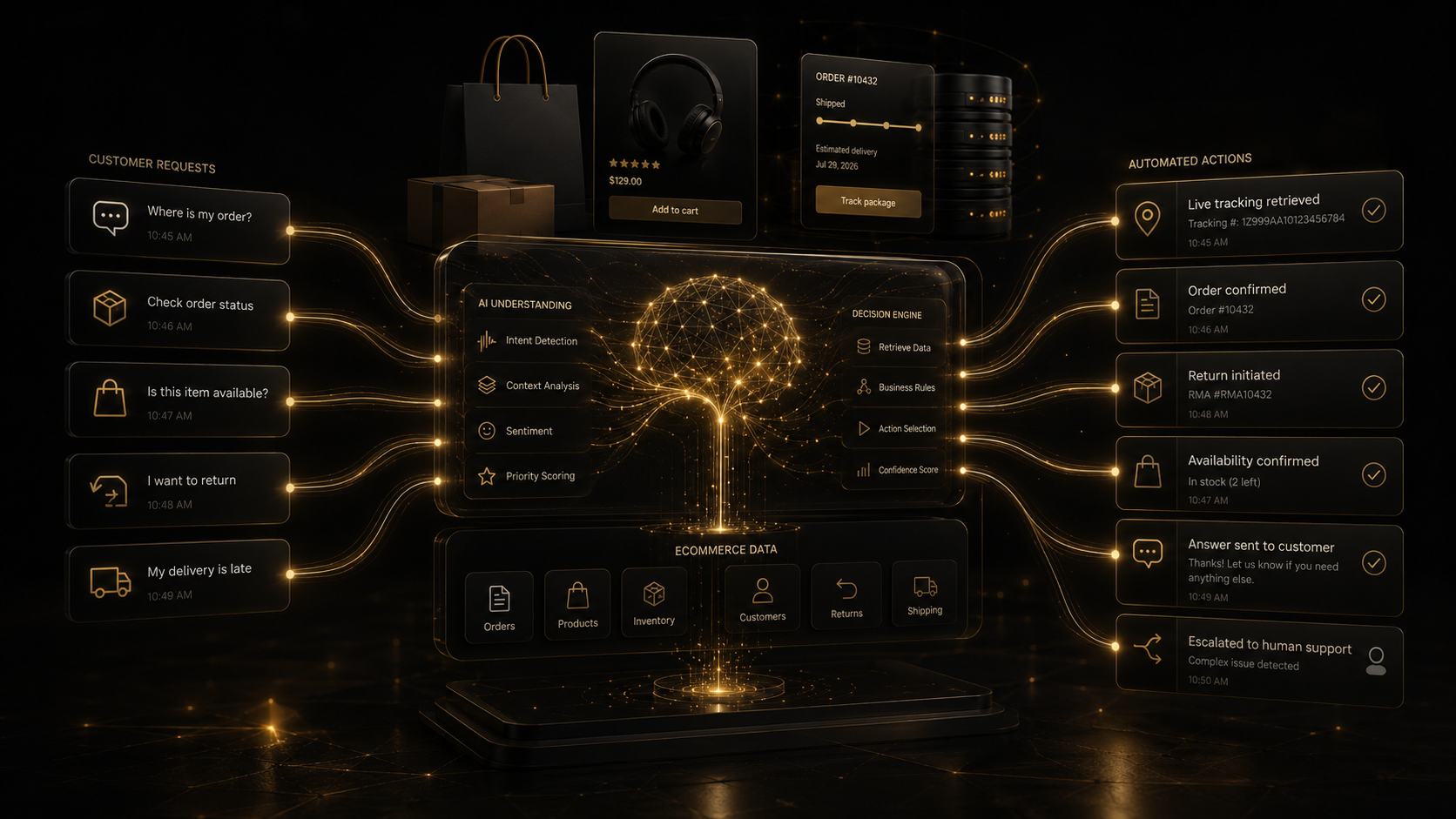
AI automation improves e-commerce customer service through faster replies, lower costs, and round-the-clock coverage. AI customer service for e-commerce stores now covers order tracking, returns, and product questions. Often, a human never touches the first reply.
At Aurixlab, we work with online stores that deal with repetitive tickets daily. This guide breaks down the real benefits of AI automation in customer service. It also covers where automation actually fits an online store.
AI automation in customer service means software that answers, routes, and resolves tickets. It works without a human on every case. Customer service automation covers three layers: chat, voice, and self-service.
An AI chatbot handles the chat layer. It answers common questions through text, right on the store's site.
A conversational AI assistant goes a step further. It holds a back-and-forth exchange. It remembers earlier messages in the same chat.
An AI virtual assistant can also complete actions. It can update an order or issue a refund, not just answer a question. Take a shopper asking where their package is. They get a real tracking number, not a generic reply.
Automated customer service is not new. Rule-based bots have answered simple questions for years. The relationship between AI and customer service keeps changing. Models get better at reading intent, not just keywords.
Businesses researching AI for customer service today usually mean this broader shift. AI customer service now covers far more ground than old-style bots ever did. Ecommerce automation has followed the same path. It moved from simple rules to real understanding.
Agentic AI is the biggest shift in e-commerce customer service right now. Agentic AI describes systems that take action on their own. They work inside defined limits, not just draft a reply. Agentive AI is often used as another name for the same idea.
AI support agents can check an order or apply a discount. They can process a return directly inside the store's system. Customer service AI agents differ from older chatbots in one key way.
A chatbot drafts an answer. An agent completes the task.
This distinction matters for e-commerce specifically. A WISMO question means "where is my order." Shoppers ask it the same way thousands of times a month.
An agentic system pulls the real shipping status right away. It does not guess from a template. Stores adopting AI support agents in 2026 report faster resolution. This shows up most on repetitive tickets like WISMO.
Adoption backs this up. By 2026, roughly 80 percent of customer service organizations use some form of AI agent. That is up from under half just three years earlier.
The core benefits of AI automation in customer service are speed, lower cost, and constant availability. 24/7 customer support automation for ecommerce means a customer browsing at 2 a.m. gets an answer. They do not get a contact form instead.
Salesforce research shows 83 percent of customers expect an immediate response from a business. Round-the-clock coverage meets that expectation without a night shift on payroll.
Cost is the second benefit. Businesses that reduce customer service costs with AI ecommerce report real savings on ticket volume alone. A single AI-handled chat often costs under $2.
A person handling a phone call can cost $15 to $25 per call. That gap adds up fast once half of routine tickets move to automation.
AI customer service response time improvement is the third major gain. Response time often drops from hours to under two minutes.
Zendesk's 2025 CX Trends report tracked businesses using AI for tier-one tickets. Their satisfaction scores rose 18 percent within 90 days. Customers simply stopped waiting.
AI customer experience also improves through omnichannel customer support. Chat, email, and social messages connect to one customer record this way. Self service support and self service customer support matter here too.
A shopper can check an order or start a return alone. They do not wait on anyone, at any hour.
E-commerce stores apply AI automation mainly to order tracking, returns, and repetitive pre-sale questions. Order tracking automation handles the single biggest ticket category most stores face. That category is "where is my order."
AI automation for order tracking and returns checks the store platform directly. It returns real shipping and refund status, not a guess.
Live chat automation covers the second major use case. It answers on-site chat instantly. It hands off to a person only when the question needs judgment.
Some stores go further with AI chatbot for automated live chat support. This blends a bot's speed with a live agent's backup.
Customer support automation extends past chat into email and helpdesk tickets. An AI helpdesk sorts incoming tickets by topic and urgency. It answers the simple ones outright.
Automation extends past customer questions too. AI customs automation e-commerce tools speed up cross-border paperwork. This cuts the delays that create support tickets in the first place.
An AI chatbot is usually the first automation tool an online store adds. E-commerce chatbot tools sit on the storefront. They answer sizing, shipping, and stock questions in real time.
AI chatbots for e-commerce platforms now connect directly to product data. Answers stay accurate as stock changes.
AI-powered customer service goes beyond the storefront widget. Customer service AI chatbot tools also run inside email and social inboxes. Replies stay consistent across every channel this way.
AI chatbots for online store customer support typically resolve 60 to 70 percent of incoming questions. It does this without a human touch, based on data from tools like Tidio's Lyro agent.
The best AI customer service tools for e-commerce differ mainly by platform fit. Gorgias and Shopify Inbox both connect natively to Shopify order data. AI-powered customer support for Shopify stores can edit an order through either tool.
It can also issue a refund directly. It does not just draft a reply for a human to send.
This kind of setup takes real integration work. The chatbot, the store platform, and order data all need to connect properly. Aurixlab builds e-commerce websites and the automation systems behind them. A chatbot connected this way reads real order and inventory data, not guesses.
How to automate customer service for an online store starts with mapping repetitive tickets first. Pull the last 90 days of tickets and sort them by topic. Order status, returns, and sizing questions usually make up more than half the total. Automate those first.
AI customer service software for small business options range from simple chat widgets to full platforms. Customer service automation tools at this level connect through an app store integration in most cases.
Setup takes hours, not weeks. AI automated responses handle the routine half right after setup.
Larger stores with unusual workflows sometimes skip off-the-shelf tools. They pay for custom software services instead. These get built around their exact order, return, and loyalty rules. AI and automation, handled this way, scale past what a template tool supports.
Start with the ticket type that costs the most staff hours. WISMO questions are almost always the best starting point. They make up the largest single category for most stores.
Deflection rate alone is the wrong number to track. A high deflection rate can mean customers gave up, not that AI solved their problem. Resolution rate paired with CSAT tells the real story. Track both together, not deflection alone.
Vendor demos often claim 90 percent automation or higher. Real deployments across many stores land closer to 55 to 70 percent. That gap is normal, not a sign something is broken.
Three mistakes cause most failed rollouts. The first mistake is a missing knowledge base. AI cannot invent an accurate return policy. It needs real, current documentation to work from.
The second is no clear escalation path. Every deployment needs a trigger point where a human takes over.
The third is a set-and-forget mindset. Return policies change. New products launch. Shipping timelines shift.
An AI system needs regular updates to stay accurate. Stores that check both numbers monthly catch problems before customers complain publicly.
AI vs human customer service for e-commerce is not really a competition. The two work best together. AI handles repetitive, rules-based questions: order status, return policy, sizing charts.
A person handles anything involving judgment. That includes a damaged shipment, a billing dispute, or an upset customer.
Nextiva's 2025 CX Landscape Report checked in with CX leaders on this handoff. 98 percent called a smooth AI-to-human handoff essential. When a bot passes a case with no context, the customer repeats the story. That single failure point damages trust faster than a slow reply does.
Conversational AI assistants close this gap. They carry the full chat history into the handoff. AI virtual assistant tools that share order data with human agents help too. Gartner's 2025 research found this cuts resolution time by 35 to 45 percent on escalated cases.
AI automation only works as well as the e-commerce business and website behind it. A chatbot cannot pull accurate order status from a site with broken inventory syncing. Clean data comes first.
Automation comes second. Site speed, checkout flow, and inventory accuracy all feed into how well automation performs later.
This applies across e-commerce business types too. Business-to-business (B2B) e-commerce stores need automation tuned differently. Account-based ordering and bulk pricing do not follow a single consumer checkout flow.
E-commerce websites built without this in mind usually need rework. Automation only delivers real results after that rework happens.
Aurixlab builds both sides of this. We build e-commerce websites with clean data, plus the automation systems that run on top.
Does AI replace human customer service agents? No, AI does not replace human customer service agents in 2026. AI resolves routine tickets like order status and returns. Complex complaints, billing disputes, and emotional situations still require a person. Gartner predicts zero Fortune 500 companies go fully human-free by 2028.
Is AI customer service worth it for small businesses? Yes, for most small e-commerce businesses. AI customer service software commonly handles 60 to 80 percent of routine questions instantly. It costs a fraction of a new hire. It also runs around the clock. Complex or emotional cases still require a human agent on standby.
How much does AI customer service cost? Costs vary by tool and ticket volume. Entry-level AI chatbot plans often start near $30 to $40 per month. Usage-based add-ons apply for higher volume. A single AI chat resolution typically costs under $2. A person handling a phone call costs $15 to $25 per call.
Can AI handle customer complaints? AI can handle straightforward complaints well. A late order or a wrong item are good examples. It checks order data and offers a fix instantly. Complex complaints need different handling. Route refund disputes, safety issues, or angry customers to a human agent with full context.
What is the best AI chatbot for Shopify? Gorgias and Shopify Inbox both integrate directly with Shopify order data. Most general-purpose chatbots cannot access that data. Tidio's Lyro AI agent is a common starting point for smaller stores. The best fit depends on order volume and budget. It also depends on how deep the tool reaches into Shopify.
Is AI customer support good for a small ecommerce business? Yes. Small e-commerce businesses often gain the most. A small team cannot staff support around the clock alone. AI customer support covers off-hours questions and frees staff for complex cases. It also scales during sales spikes without new hires. Response time usually drops from hours to minutes.